Red List Review 2026 for Great Britain’s Dragonflies and Damselflies
UNITED KINGDOM / AGILITYPR.NEWS / October 15, 2026 / Freshwater sentinels tell their story
The British Dragonfly Society (BDS) has today published a major new assessment of the extinction risk facing Great Britain’s dragonflies and damselflies: A review of the Red List status of the Odonata of Great Britain 2026.
The review updates the earlier 2008 Odonata Red Data List for Great Britain, assessing the status of our dragonflies and damselflies. Red Lists provide an internationally recognised assessment of species’ risk of extinction and provide important evidence to help inform conservation action. Dragonflies and damselflies are widely recognised as valuable indicators of the health of freshwater habitats, making changes in their status an important part of understanding wider environmental change.
The review, commissioned and partially funded by Natural England, assesses 46 established breeding species against internationally recognised IUCN Red List criteria, drawing on more than 1.3 million records collected over 20 years. The assessment also incorporates trend metrics and a risk-of-bias assessment provided by the UK Centre for Ecology & Hydrology (UKCEH), helping to inform the assessment of species’ threat status.
“Understanding how species are faring is a critical part of Red List assessments, helping us identify which species are most at risk of extinction.
These assessments would not have been possible without the efforts of thousands of wildlife recorders and citizen scientists, who contributed more than 1.3 million species observations on which the trends are based. By combining these records with state-of-the-art analytical methods, we were able to produce robust estimates of how species distributions are changing across Britain.” Dr Gary Powney, Quantitative Ecologist, UK Centre for Ecology & Hydrology
Brilliant Emerald – Dave Smallshire
The review reveals a mixed picture, with some species showing range expansion while others face increasing extinction risk. Climate change, habitat degradation, habitat loss and fragmentation continue to put pressure on dragonfly and damselfly species, with impacts varying across the country.
More species are now at risk:
One of the most significant findings is the increase in the number of species classed as Endangered. Eight species are now classed as Endangered, twice the number identified in the previous assessment in 2008.
Four species have moved into the Endangered category since the previous assessment:
- Brilliant Emerald - previously Vulnerable
- Azure Hawker - previously Vulnerable
- Northern Emerald - previously Near Threatened
- Scarce Blue-tailed Damselfly - previously Near Threatened
Others, including Common Hawker, are showing concerning trends, with its status moving from Least Concern to Near Threatened. Some species, including Black Darter, have also been flagged for monitoring due to ongoing population decline, although they have not yet reached the threshold for an increase in threat category.
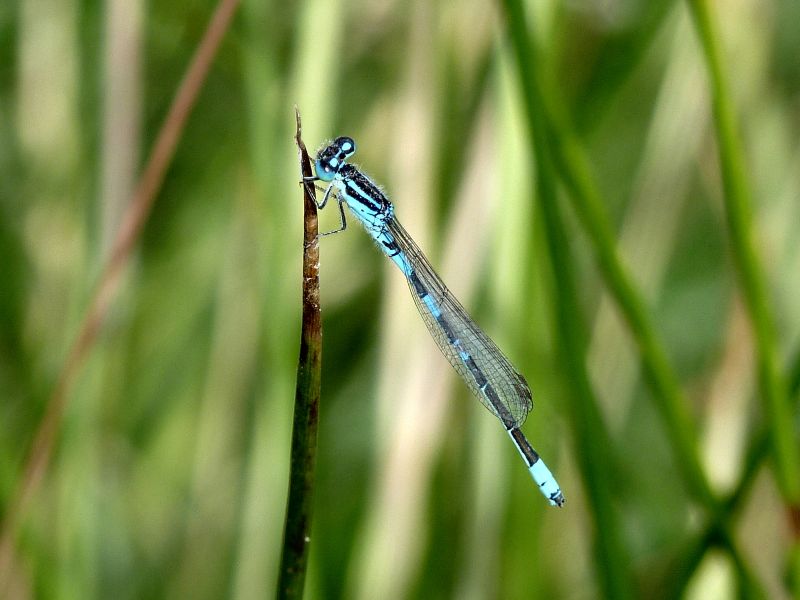
Dainty Damselfly – Dave Smallshire
There are also reasons for hope:
The review also highlights positive changes and successful conservation action.
Great Britain now has a more diverse Odonata community, with 44 extant established breeding species, compared to 39 in 2008. Large White-faced Darter, Yellow-spotted Emerald and Winter Damselfly are now included.
Dainty Damselfly, previously considered Regionally Extinct in Britain, has returned and successfully bred in Kent. It is now classed as Endangered.
Four species have improved and been re-categorised as Least Concern: Variable Damselfly, Scarce Emerald Damselfly and Scarce Chaser, which have moved from Near Threatened, and Norfolk Hawker, which has moved from Endangered. These changes reflect positive developments in the status of these species, alongside targeted conservation efforts.
“This review and its findings demonstrate the complexity and geographical variation in the impacts of a changing climate, highlighting how these can create both threats and opportunities for species across the country. It represents years of recording effort by volunteers, ecologists, and conservation professionals and is an invaluable tool in helping to focus our conservation efforts where they are most needed and to more deeply understand the status of our dragonflies and damselflies and their freshwater habitats.” Pam Taylor, Chair of Trustees, British Dragonfly Society
“We are delighted to have worked with the British Dragonfly Society to produce this new Red List for Britain’s dragonflies and damselflies. The assessment demonstrates the value of strong partnerships and robust scientific evidence in understanding how our wildlife is faring. Its findings will help guide conservation action for threatened species and the habitats they depend on, helping us target efforts where they can make the greatest difference.” Kate Morris, Senior Specialist – Species Recovery, Natural England
Notes to editors:
Photographs: We request that if using any of the images supplied, a picture credit is provided for the relevant photographer. Images should only be used in conjunction with this press release. Link to download images - https://www.dropbox.com/scl/fo/pptivce75uh1t33f09kg5/ANvy3LffT0WlKmI8moBbHI8?rlkey=t6lprvrc2wc7s2fkd4il5zfk6&st=0r6uwk5e&dl=0
Contacts
Dakota Digital
hello@dakotadigital.co.uk